Case Study: Mohawk Bend Brand & Identity Development

mohawk bend brand & identity

As the saying goes, I love it when a plan comes together. When I first talked to Tony Yanow about his newest venture, Mohawk Bend, it was nearly a year ago, midway through the Ramona Theater’s renovation process. While we’d be working from scratch design-wise, Tony had a very clear idea of who he was serving and what the attitude and voice of Mohawk Bend would be, which made the preliminary research and brand brief development really easy. He also had an interior design team working with the raw materials of the space and adding beautiful custom furniture in light wood and warm, orange tones. From the outset, we knew the setting of where the identity would live and how we could make it stand out appropriately within that environment.

mohawk bend logo

logo development

Mohawk Bend has a few different areas of focus, but it’s first and foremost a celebration of craft beer from all over California. The most exciting and innovative of these is the hops-forward west coast IPA, and in that vein, the hop flower became a main feature of the logo.


mohawk bend icon system

mohawk bend business cards

building an identity

Beyond beer, though, their plans included California-sourced spirits, a bottle-free selection of California wine, local / organic food that spans the vegan-omnivore spectrum, and a low-waste operation in the kitchen. Tony really wanted an icon system that could represent each of these aspects and work interchangeably with the main identity, play out on the web site, and associate with core staff’s areas of expertise. We developed a color palette and selection of icons that swap out with the hop flower in the logo for specialized uses, and become indicators for each area of the web site. For future signage and events, they’ll have the versatility of growing this icon system with new developments.


mohawk bend web site home page

keeping it simple & highly useful online

Creating the web site was a fun exercise in brainstorming all the things we hate about restaurant web sites and putting them at the top of the list of what not to do. No flash, No pdf menus, No hard-to-find location information. Tony was always very clear about the voice of Mohawk Bend, that it’s craft first in a simple and honest way. We were still excited to talk about all the great things Mohawk Bend does, however, so we built all of it into the about section, so the information is there without being an obstacle on the home page. Instead, a styled twitter widget announces daily specials and events, with clear postings of hours, location, directions and a list of menus: get the info you need and come on over!

mohawk bend web site interactive beer list

the interactive beer list

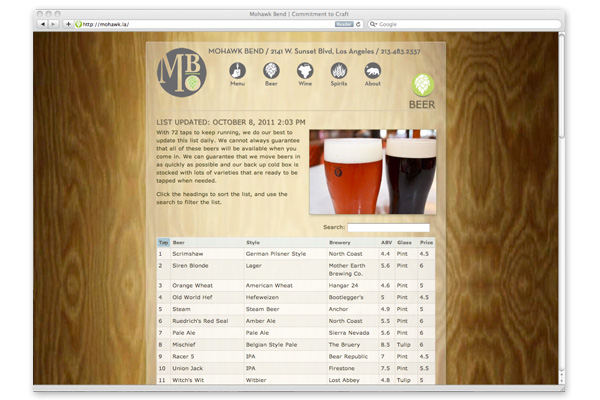
One particularly fun feature is the interactive beer list. During our preliminary talks on functionality of the site, Tony said “What I’d really like to have is a beer list you can sort by any category—brewery, style, alcohol volume…” And so we thought about it, and worked out a solution that integrates directly with WordPress, allowing all the searching & sorting a curious beerophile would want. Click any column header to sort by that column, or use the search field to isolate beers containing your search terms. We also translated everything to a nice mobile site, so anyone can find just what they’re looking for [even search the beer list] on the go.


mohawk bend menus

beyond design: a workflow that works

Behind the scenes was the real challenge: developing a workflow system that would allow daily menu updates in print and online to be done easily and quickly by employees. A system that still uses nice typefaces and formatting in print, but doesn’t require any coding online—and all simple enough to execute well without a design education. Once we settled on a menu format, we built in-house layout templates using paragraph styles that would transfer heading tags and basic bold and italic formatting to WordPress. The WordPress interface is extremely user-friendly, with a visual editor, so everyone has taken to it quickly. To keep the carbon footprint low, the menus are printed on Neenah Environment 100% post-consumer waste recycled paper.


mohawk bend extended identity

and they’re off…!

As I’ve watched this roll out in action and seen the Mohawk Bend staff make it their own, I’m proud of the system we created together. They’ve been able to switch around the menu formats easily using feedback from customers, and we’ve been able to build more of the identity into ads, stickers, signage and support collateral. Best of all, they are all super-nice people to work with, so we’re always happy to walk down, have a beer, find out how everything is going, and help them work out their next adventure. Bottoms-up to Mohawk Bend!

+ Read more case studies here.
+ See more of our work for Mohawk Bend here.

article of the week

Sometimes a Brand isn’t Worth Saving: Here’s How to Tell by jump associates for fastcodesign.com

i’m really looking forward to following this series by jump associates. in this first piece, they present 5 important questions to ask in order to determine whether a brand can breathe new life through revitalization, with great examples of how brands that may have seemed stagnant reexamined their options and told new stories.

article of the week

How Starbucks Turns Coffee from Commodity to Splurge: Brand Thinking by Debbie Millman.

debbie millman interviews stanley hainsworth, who has worked with starbucks, nike and gatorade, about the essence of branding, how it works, and what happens when it doesn’t. if you think branding itself is a pretty obvious concept and want to leave it at that, this interview can give you some insight as to why we keep coming back to the core values and stories, and never stop striving to connect you with your clients.

10 days of loving LA

LA river, north
looking at the LA river northwest from fletcher bridge

something fun for friday, alissa walker is celebrating 10 years in LA with 10 posts leading up to her birthday, and they are all fantastic! take a spin through her LAX tag and read them all!

article of the week

You Can’t Innovate If You Ignore Real Problems by Sohrab Vossoughi for fastcodesign.com.

i’ve seen this time and again both in-house and out, and i think it’s an important topic for any business facing a brand overhaul, evolution or innovation. many thanks to sohrab vossoughi for writing about it! the dilemma, as it comes to the designer: a business is experiencing a dip in brand loyalty or otherwise tough times, wants to shift the focus of previous perceptions and tell everyone how great they are, but doesn’t want to change how they operate, what they offer, or do the real work of aligning this message with who they truly are.

it’s tough to really look at ourselves and our businesses objectively and find out if our actions or corporate culture really reflect what we say about ourselves. sometimes we’re too close to the matter, and it helps to get an outside perspective. the fact is, though, branding is not about creating an external façade. it’s not between you and your customer, it’s the very articulation of what you stand for and what you do—it IS you. many of your potential customers have been advertised to, rather loudly, their entire lives at this point, and are discerning about messages that don’t align with a business’ actions or services. if you’re realizing there’s a problem that’s not working for you, re-evaluating your brand is a good idea, but first it’s time to take that look.

read on & have a great weekend!

tell your clients what to expect

design project timeline
while job specifics vary, the process follows the same path.

we get so familiar with our own businesses and practices, that even though we may explain what it is we do, sometimes that’s really different from empathizing with the outsider’s unfamiliarity with our services. let’s not leave these things to their imagination. when we’re in the position of buying, often what we’re conscious of is the artifact, or the end result we’re shopping for, but our senses are busy researching the experience we’re buying as well. is this a good person to work with? will this business really take care of me? think about how you feel when you read testimonials that express excellent customer service—it’s a wave of relief, trust, and a subconscious vote of confidence.

recently i was preparing a brand brief for my father’s new hypnotherapy practice, and in researching other hypnotherapists in the immediate area, we only found one practitioner who took the time to walk through what a patient could expect when they sign on with her therapy practice. everyone else had a lot to say about what hypnotherapy does, took time to dispel myths about what it’s not, and made sure to list their credentials, but only one practitioner dedicated a page to what happens in her office after you walk through the door. it wasn’t information i was expecting to get, but when i did it allowed me to picture myself doing it, which was a powerful surprise. most of them let the reputation of hypnotherapy sell for them, she sold her personal touch on the experience.

finally, this past week, the AIGA held one day for design as an open forum for discussing the future of design. the discussion was varied, but there were a good deal of voices calling for the industry leaders to educate the public on the value of design, with an undercurrent about clients just not getting the true value of what we do. i gotta say, it doesn’t work that way. educating people on what any of us do in our businesses, and how it can be valued and leveraged is entirely up to us. the less tangible your service, the more important it is to show case studies, offer examples, and answer questions about how it works. our industry organizations are there to back us up and support us, not sell our services for us so we don’t have to. take charge of the conversation and have it wherever you can!

spend some time with your own marketing materials and ask yourself how much you’re speaking directly to potential clients to help demystify exactly what service you offer. try not to rely so heavily on the deliverables—unless you’re selling an entirely unique product or service, they generally know what artifactual item they’re shopping for. appeal to the instincts that are comparing experiences. if you have a web site, and look at analytics, let some of the more popular and unexpected searches be a guide as to what potential clients are yearning to learn from you. tell them about what you bring, and how you bring it.

some tips:

• don’t assume people know even the basics of how your industry works. write up a draft from start to finish of your ideal process, writing to the kind of project you’d like to be doing.

• use past experience as an example: take cues from every time you’ve had a disconnect with a client, or realized they assumed things would go differently. this is what people don’t know about how you work—tell them about it!

• ask clients for feedback on how you helped them understand the process. ask them if there are standout factors that help them decide between two similar services. what are their deal-makers & deal-breakers?

marketing mentor podcast: how to transition to freelance

marketing mentor

i did an interview with ilise benun of marketing mentor and creative freelancer blog about how to transition to freelance, all the things you want to plan and the mindsets you want to change. working with ilise through marketing mentor has helped me refine so many of my marketing practices, given me great ideas about where to expand, and helped me stay on track and forge ahead. i was honored to be able to contribute to her podcast and encourage anyone else to make the jump.

listen here: how one creative made the transition to full-time freelancing from marketing mentor

how to profile your target markets

parlato design studio news how to profile your target markets

part of the process of an identity development involves profiling the target markets of the client, so we can get a good idea of exactly who we’re talking to. it’s one thing to know what you want your business to say to everyone, but the reality is, you’re in a dialog with your very best clients and potential initiates to your tribe. don’t address them to whom it may concern, create a sketch of who they are and talk to them like you know them—because you do!

i can usually help with a little knowledge, research and brainstorming, but nobody knows their client base better than you. whether or not you’re in a phase of identity development, taking time aside to visualize your clients and empathize with their concerns will always help you better align your communications with their needs.

start by looking at your very best clients.
these are often people you don’t have to sell to anymore, those who understand the value of your services and are happy to keep coming back. it’s never just one type of person though, so take a look at the various types of people that comprise this group. what do they have in common, what led them to you? what are their differences? do they come from different earning brackets, different areas, different cultures? how many different groups do you have?

select three main groups by common attributes.
take what you learned by listing out client traits and behavior, and create three general client profiles. then for each, outline their individual characteristics that make them unique. where do they work, do they have kids, what would a typical day for this customer be like? what do they care about, what are their values, do they tend toward one political party? how does your business fit in? chances are, each group interfaces with your business differently, how do you usually help each group?

start using the profiles as clues for your next step.
once you have your main customer profiles and a clear statement of how you help each one, consider each one individually and try to think of other ways you might serve them. you’re talking about groups that have already bought into what you do, so they’d be your most likely audience for anything new you offer that’s relevant and useful to their daily grind. additionally, focusing on the types of people you profiled is the best way to create products and services that similar types might use, so you’re not only serving your targets, you might also discover new branches you hadn’t thought about before.

save these customer profiles, and make sure to refer to them in any brainstorming meetings on upcoming product and service developments or preparations for ad campaigns. if you break into a new sector, profile the new market and add them to the bunch. having these target profiles on hand will help keep everyone on track with who your messaging is going to, so you can make sure it’s always relevant, and revise as necessary.

3 ways to kick-start 2011

3 ways to kick-start 2011 parlato design studio

so here we are, a new year is just beginning and everyone is energized to start fresh. it’s a great feeling, but before it fades and settles behind a daily grind, harness and focus your energy so you can let it help you make progress on your most important goals and stay motivated throughout they year.

take stock of where you’re at
if you did any year-end planning or creative retreating, you probably already have a road map for the year ahead. if not, it’s a great time to take a day and look back at the biggest progress you made last year, the most effective efforts, the best projects, and find ways to build on them or continue rolling them out. how did your marketing plans play out for you? were you surprised by the results of any actions you took? better yet, did you learn what worked well and what isn’t worth the effort? do you have lingering projects that stayed on the back burner, that now need attention? does your brand, messaging or site content need a little refresh to match some new directions you’re taking? it’s time to strip down to a mix of what works best for you, toss the rest in a box [you can revisit it later if you want] and refine what you’re keeping so it keeps working for you in the new year.

assess the landscape ahead
knowing yourself, your internal strengths and where to put your energy is one thing, but what’s the terrain you’re going to travel? are you continuing to work with familiar industries and clients, or are you going to develop a new niche? are you in a plateau phase of familiar territory, or in a growth phase where you’ll be learning and trying all kinds of new things? take stock of the things you can depend on, and the areas you’re less familiar with. make sure to keep investing good energy in the familiar places, grow with it and don’t take it for granted. but, what are the biggest things you want to learn about the new places you’re going? can you read up on them, can you research some good starter events to get your feet wet, can you get some initial meetings with friendly informers who are happy to help you get to where you want to be?

pick a strategic blend and plan your moves
once you have a more clear sense of what you do best, how you do it, and the lay of the land ahead, take what you know and apply it—to the calendar! start with what you know: your best and most long-standing clients. plan a mix that works for you, attend the events where you know you’ll see them, think about your own brand touchpoints and which communicate the best with your home-base. you know these people really well at this point, maybe even research how you might better serve them, or find some aspect of their businesses that is largely overlooked. if you’ve attended mixers to see them in the past, consider hosting your own and inviting them for a regular check-in outside the office. in short, make your best relationships even better.

if you’re breaking ground in a new industry or niche, start a regular schedule of research, read the industry blogs, look for events to attend, make contacts and ask questions so you can learn from the personal experience of others. research the archetypes in the industry and get to know how they communicate, what’s important to them, go where they go. eventually, with regular research and exposure, you’ll have a great idea of who might be a good fit for you as a client or what might be a best first project to get your foot in the door.

and, of course, the best way to communicate with them when you’re not actually in the same room is to make information readily available about your own services and show that you’re aligned with this new industry. if you’ve been meaning to refresh your print collateral or web site content in this way, chart it out and put it on the calendar. if you can’t afford the dream overhaul, do the realistic refresh now. as seth godin often says, plan what you can, don’t let fear of failure hold you back from shipping, and put yourself out there!